
How the Avit SOC Stopped a Ransomware Attack
Most ransomware reports start at the endpoint. This one begins above the firewalls.
In July 2026, the security operations team at Avit responded to a live attack against a customer environment. Attackers had infiltrated a Cisco Secure Firewall Management Center (FMC), navigated through Active Directory and related infrastructure, and were poised to roll out encryption. Avit contained the attack before encryption could succeed, restored the customer’s environment, and supported the partner collaboration that led to Cisco Talos’s public analysis of FMC exploitation, including acknowledgment of Avit regarding the Qilin affiliate cluster being tracked as UAT-11988.
This article is for peers: the kill chain, where detection was too late, where the response was swift, and what operators with similar systems need to adjust as quickly as possible. If you’d prefer to read the general overview, you can find it here.
More specifically, we discuss the initial access via the FMC, the attackers’ subsequent behavior consistent with a Qilin RaaS affiliate (Talos: UAT-11988 / Cluster #3), the containment and IR approach from Avit, and concise insights from information recovered on infrastructure controlled by the attacker, along with several practical lessons. We are not sharing partner-specific IOCs or any evidence obtained, as the criminal investigation is still ongoing at the time of writing.
ACTOR CONTEXT
Qilin (historically also known as Agenda) is ransomware-as-a-service. Core operators maintain the malware and payment channels. Affiliates carry out the attacks.
Talos assesses Cluster #3 for compromised FMC instances (UAT-11988) with a high degree of reliability as a Qilin affiliate, and we thank Avit for its contribution to that research. Other clusters in the same FMC exposure class use different tools and motives than those observed by Avit in this specific case. This blog post is about the affiliate intrusion that Avit was able to contain in time.
THE IMPORTANCE OF THE FMC
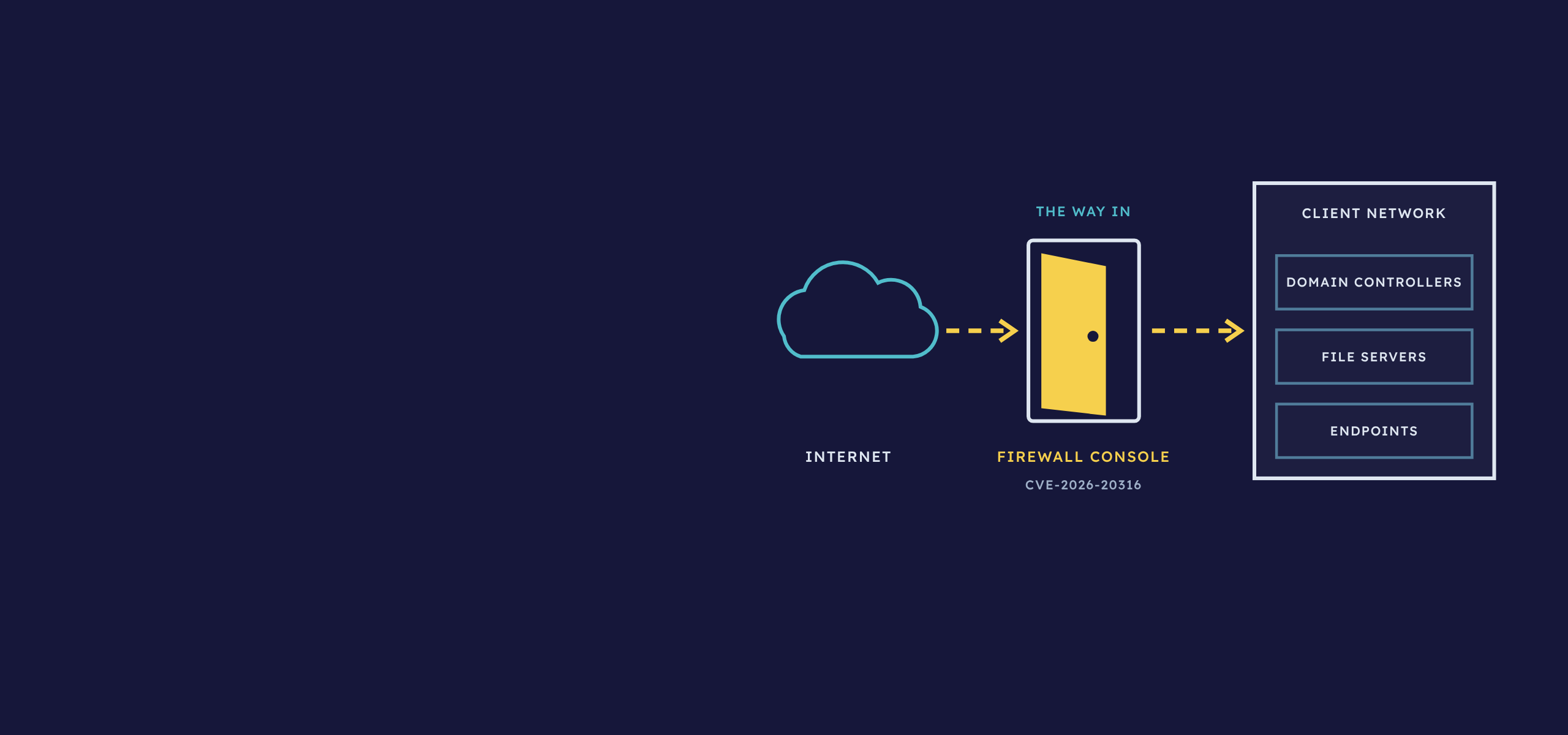
An accessible firewall management system is not just “another server.” It is a privileged vantage point over the managed devices and, in this breach, a practical platform for reconnaissance and tunneling into the underlying network.
Two Cisco Secure FMC vulnerabilities made this attack possible:
| CVE | CVSS | Role |
|---|---|---|
| CVE-2026-20079 | 10.0 | Authentication bypass to root on the underlying OS |
| CVE-2026-20316 | 5.3 (Cisco rates this as high in combination with the CVE mentioned above) | Remote login via a low-privileged/static-credential path; useful in combination with other FMC vulnerabilities for privilege escalation and “living off the land” exploits |
At the time of the breach, the relevant vulnerability had not yet been disclosed. Following this investigation, Cisco made the issues public and addressed them. The public advisory from Talos attributes the initial access via UAT-11988 to static credentials linked to CVE-2026-20316, followed by “living-off-the-land” abuse of legitimate FMC tools, in which CVE-2026-20079 was used to escalate privileges to root.
Specifically for UAT-11988, Talos describes the exploitation of built-in FMC utilities. This primarily involves executing attacker-created payloads via package_info.pl (including a malicious license.tmp(file-like object), in order to subsequently run reconnaissance with root privileges.
From the FMC, the operator collected host and IP details, directory listings, Active Directory and MySQL credentials, domain account data, computer objects, and hostname-to-IP mappings for critical roles such as domain controllers, file servers, and email systems.
Talos also explicitly mentions an extended pause, lasting approximately 36 hours, between initial access and resumed aggressive activity.
Therefore, apply Cisco’s published hotfixes and advisory guidance as soon as possible. This blog does not replace patch notes.
INTRUSION TIMELINE (ANONYMIZED)
| When (July 2026) | What happened |
|---|---|
| Early July | FMC exposure / accessibility context at the customer site |
| July 14 ~10:23 p.m. | First notable unauthorized / “report-user”-style FMC login |
| July 16 ~4:27 PM | Attack progress: SSH tunnel capacity from the FMC |
| July 16 ~4:31 PM | Adversary account created in AD via LDAP / service account path |
| July 16 ~4:35 PM | Certificates created on PKI using that account |
| July 16, afternoon–evening | Escalate endpoint alerts; leverage Microsoft Defender / EDR stack |
| July 17 ~3:59 a.m. | Attempt to mass-uninstall Cisco Secure Endpoint (AMP) |
| July 17 ~6:00 a.m. | Contact the client: Avit IR start |
| July 17 ~8:00 a.m. | Internet access to the FMC blocked; attackers’ path halted |
| The days that followed | Containment, forensics, and remediation; customer restored |
| July 18–22 | Intelligence obtained from the infrastructure controlled by the attackers |
ENCRYPTION STEPS
Encryptor files and encryption staging were detected, including a dry run. Successful encryption of the environment was prevented. The customer was protected before the ransomware encryption could take effect.
WHERE DETECTION CAME TOO LATE
The quiet phase following the initial FMC access and the resumed activity a day and a half later (SSH tunnel, AD account, certificates) did not trigger a SOC escalation. The FMC was not monitored in the same way as the other endpoints on the network. The decisive and conspicuous signal was the massive attempt to uninstall endpoint controls around 4:00 a.m. on July 17.
The attack began via an improperly exposed and inadequately monitored management system. The foothold was located where many endpoint-centric stacks do not look first. As soon as a genuine signal was detected, Avit’s response was fast enough to prevent the encryption.
POST-COMPROMISE BEHAVIOR
After gaining a foothold, its behavior was consistent with that of a serious RaaS operator:
Securing persistent access. Reverse SSH tunneling from the FMC back to the attackers’ infrastructure was set up, along with a Python SOCKS5 proxy to mask IP addresses. Forwarded ports included directory and Windows management services (LDAP/LDAPS, Kerberos, SMB, NetBIOS, WinRM). The management system became a backdoor that remained open.
Credential theft and lateral movement. Tools such as Impacket, Invoke-TheHash-style pass-the-hash execution, and scheduled tasks (including TaskCache abuse patterns) were used to further penetrate the network.
Security stack hunting. PowerShell enumeration of processes and services associated with common EDR, AV, and monitoring products, followed by attempts to disable or uninstall those processes. Cisco Secure Endpoint uninstallation scripts were executed unsuccessfully during the pre-ransomware phase. An EDR-killer component linked to KVC Killer was detected and blocked before it could run.
Notable for this affiliate family (according to Talos). Wireshark was used from an account created by the adversary to monitor local network traffic. This is not the typical behavior of a Qilin affiliate.
Encryptorstaging. The final payload was launched for a dry run from commonly used staging locations (temporary and IT-like paths), with command-line options to determine which domains, shares, and processes were in scope. Selected systems were excluded from this process. This indicated that the operator knew what he was doing, rather than simply spraying randomly.
WHAT AVIT DID
Our standard workflow under pressure:
- Protect the customer
- Secure the evidence
- Expand the circle cautiously
In this case, that translated to:
Containment. Internet access to the FMC was blocked around 8:00 a.m. on July 17. That halted the attacker’s path and gave us time to ask the questions every IR lead knows: Is there a dead man’s switch? What is the blast radius? And how did they get in?
Investigation and recovery. Endpoint investigation was initiated immediately, with a turnaround time of approximately 1.5 hours per server, run in parallel using the available tools—including Cisco XDR—which allowed analysts to move more quickly through the hosts under investigation. XDR significantly accelerated the process, but as always, the people analyzing the results are what matter most. The customer was back up and running quickly after containment and recovery.
Coordination. Avit In this case, we ultimately collaborated with NCSC-NL, Cisco Talos / Cisco, and law enforcement agencies, including the Dutch police and the FBI, and we would like to take this opportunity to thank those partners for their excellent cooperation.
INTELLIGENCE FROM INFRASTRUCTURE CONTROLLED BY ATTACKERS
After containment, intelligence was discovered from the infrastructure controlled by the attackers linked to this affiliate operation, and that data was shared as quickly as possible with national and international CERTs and law enforcement agencies.
In total, approximately 3 GB of data secured, consisting of nearly 20.000 files such as scripts, tools, victim-related material, and related encryption indicators. This provided a deeper understanding of this affiliate and showed us that our client was not the only (potential) victim. This data supported the notification of other (potential) victims—including organizations in the United States, Germany, Sweden, and Greece—through law enforcement agencies and national CERTs.
The material was also shared with Talos for defensive analysis and, of course, with investigators for case building, which is currently ongoing. Therefore, this article does not contain a complete list of IOCs. Restricted partner bulletins exist for a reason. Defenders who need indicators can start with the public FMC exploitation advisory from Cisco Talos and Cisco advisory materials, and can then consult with their vendor and national CSIRT.
Operator workflow. Parts of the discovered scripts and tools contain, in addition to quickly built scripts, a fair amount of noise, clear comment lines, and Markdown files consistent with an AI-supported workflow. For now, this is merely an observation about the method, not a proven attribution to “AI ransomware.”
ATT&CK MAP (HIGH LEVEL)
| Phase | Observed behavior | Example techniques |
|---|---|---|
| Initial access | Static credential login to FMC (CVE-2026-20316 class), followed by privilege escalation | Valid Accounts; Exploitation for Privilege Escalation |
| Execution | Attacker crafted a package via package_info.pl | Command and Scripting Interpreter; Abuse Elevation Control Mechanism |
| Discovery | Host, directory, AD, and role-to-IP mapping from the FMC | Account Discovery; System and Network Configuration Discovery; Remote System Discovery |
| Credential access | AD and MySQL data from the management plane | Unsecured Credentials |
| C2 / pivot | Reverse SSH and SOCKS5; forwards to directory and Windows management ports | Protocol Tunneling; Proxy; Remote Services |
| Lateral | Adversary AD account, PKI certificates, Impacket / pass-the-hash, scheduled tasks | Create Account; Steal or Forge Authentication Certificates |
| Defense evasion | Security product enumeration, mass CSE uninstallation, EDR killer staging | Impair Defenses |
| Impact (blocked) | Encryptor dry run and staging | Data Encrypted for Impact (attempted) |
WHAT YOU SHOULD ADJUST IF YOU HAVE A SIMILAR SETUP
Patch the management environment the same way you patch production. Issues such as CVE-2026-20079 / CVE-2026-20316 are no longer theoretical. Use Cisco guidance and hotfixes, or talk to your vendor if you’re running similar products.
Monitor the management layer as part of production. Authentication anomalies, “living-off-the-land” package abuse, unexpected tunnels originating from the FMC or your firewall, and directory/PKI changes should be treated with the same level of urgency as endpoint ransomware alerts.
Don’t treat EDR as the be-all and end-all strategy. In this case, the entry point was the firewall management path. Endpoint controls were not compromised until after the foothold was established.
Detect security stack tampering. Mass uninstalls and EDR-killer patterns are late-stage indicators, but they were also the signal that led to this customer’s rescue that Friday morning.
Restrict outbound tunneling from management hosts. Reverse SSH and SOCKS proxies originating from FMC-like systems should be difficult or impossible to set up and easy to detect.
Record data in a way that preserves evidence. Blocking FMC internet access cut off the path, without panicking and destroying evidence—for example, by immediately re-imaging the endpoints.
We have a contact channel that’s available even at 6:00 a.m. In a situation like this, time matters more than fancy strategy decks. Make sure you have a number to call as soon as staging begins.
Plan for partners before you need them. The NCSC, vendor PSIRTs, Talos, and law enforcement present a coordination challenge. They don’t spring into action based on a LinkedIn DM.
GOOD TO KNOW
Talos’s public advisory also publishes Snort coverage for these CVEs and related malware, including the SIDs mentioned in the September 9, 2026, advisory. Start there if you want network detection content.
CONCLUSION
Avit Avit is known in the Benelux as a networking company and a Cisco Preferred Partner. However, it also operates a 24/7 security operations center alongside its network engineering teams. This case demonstrates how that combination works under regulatory pressure: implementing encryption, retaining evidence, coordinating with partners, and keeping the client’s name out of the headlines.
A friendly penetration test of your own designs isn’t the most compelling proof. Defending a live environment when a real ransomware crew shows up certainly is.
REFERENCES
- Cisco Talos, “Active exploitation of Cisco Secure Firewall Management Center vulnerabilities,” September 9, 2026: https://blog.talosintelligence.com/fmc-ongoing-exploitation/
- Cisco security advisory materials and hotfixes for CVE-2026-20079 and CVE-2026-20316
- Avit Narrative dossier: The Door They Thought Nobody Watched (The “ Avit ” Files, coming soon)